Last updated:
In Florida, a lender does not need a judge’s permission to take your car. Car repossession in Florida is a self-help remedy: once you are in default, the lender can send a recovery agent to collect the vehicle without ever filing a lawsuit. What the lender cannot do is breach the peace to get it — and that limit, along with a short list of deadlines, is where most of your leverage lives.
This guide from Szabo Law Group explains how car repossession in Florida actually works, what the lender owes you before and after the vehicle is sold, and eight ways to stop a repossession or undo one that has already happened.
What This Guide Covers
- How car repossession in Florida actually works
- The breach of the peace limit
- What the lender must do after taking the car
- 8 ways to stop a car repossession in Florida
- Leases, title loans and buy here pay here
- Getting the vehicle back after it is gone
- The deficiency judgment that follows
- What a repossession does to your credit
- 5 mistakes that cost people their car
- Frequently asked questions
How Car Repossession in Florida Actually Works
Florida follows Article 9 of the Uniform Commercial Code. Under Fla. Stat. § 679.609, a secured creditor may take possession of collateral after default either through the courts or “without judicial process, if it proceeds without breach of the peace.” In practice, lenders almost always choose the second route, because it is faster and cheaper.
What counts as default
Every car repossession in Florida starts with a default, and the definition is narrower than most borrowers assume.
Default is defined by your contract, not by state law. One missed payment is usually enough on paper. Letting insurance lapse is also a default in most retail installment contracts, and it triggers more car repossession in Florida than borrowers expect. Read the agreement before assuming you know where the line is.
No advance notice is required
This is the part that shocks people. Florida law does not give you a statutory right to cure before the vehicle is taken, and no advance warning is required. Many lenders send a courtesy letter anyway, but the absence of one does not make the repossession unlawful. The first notice the law actually guarantees comes after the car is gone.
Who is allowed to take the car
Recovery agents are licensed by the Florida Department of Agriculture and Consumer Services under Chapter 493 of the Florida Statutes. An unlicensed person taking your vehicle is a problem for the lender, and any car repossession in Florida carried out by one is worth challenging.
The Breach of the Peace Limit
This is the single most important restriction on car repossession in Florida, and the one lenders most often push past.
“Breach of the peace” is not defined in the statute, which means courts decide it case by case. The recurring fact patterns are consistent enough to be useful:
- Almost always a breach: breaking a lock or chain, opening a closed garage, entering a fenced or gated yard without permission, using or threatening force, impersonating law enforcement.
- Usually a breach: continuing after you or another adult on the property clearly objects and tells the agent to stop.
- Usually not a breach: taking the car from a public street, an open driveway, an employer’s lot or an unsecured apartment parking area while nobody objects.
Why it matters: a repossession carried out through a breach of the peace can expose the lender to damages and can undercut or eliminate its right to collect a deficiency. If it happened to you, document it immediately — photographs, video, the recovery company’s name, the time, and the names of any witnesses.
What the Lender Must Do After Taking the Car
Once the vehicle is in the lender’s hands, the rulebook flips. Now the statute imposes real obligations, and every one of them is a potential defense in a car repossession in Florida dispute.
| Stage | Timing | Your right |
|---|---|---|
| Vehicle taken | Day 0 | Retrieve personal property from inside |
| Notification of disposition sent | Safe harbor: 10+ days before sale | Must state the redemption amount and a phone number to get it |
| Redemption window | Until the sale happens | Pay the full payoff plus costs and take the car back |
| Sale (auction or private) | After the notice period | Sale must be commercially reasonable |
| Deficiency demand | After the sale | Lender must prove the numbers |
| Deficiency lawsuit | Within 5 years | Statute of limitations defense |
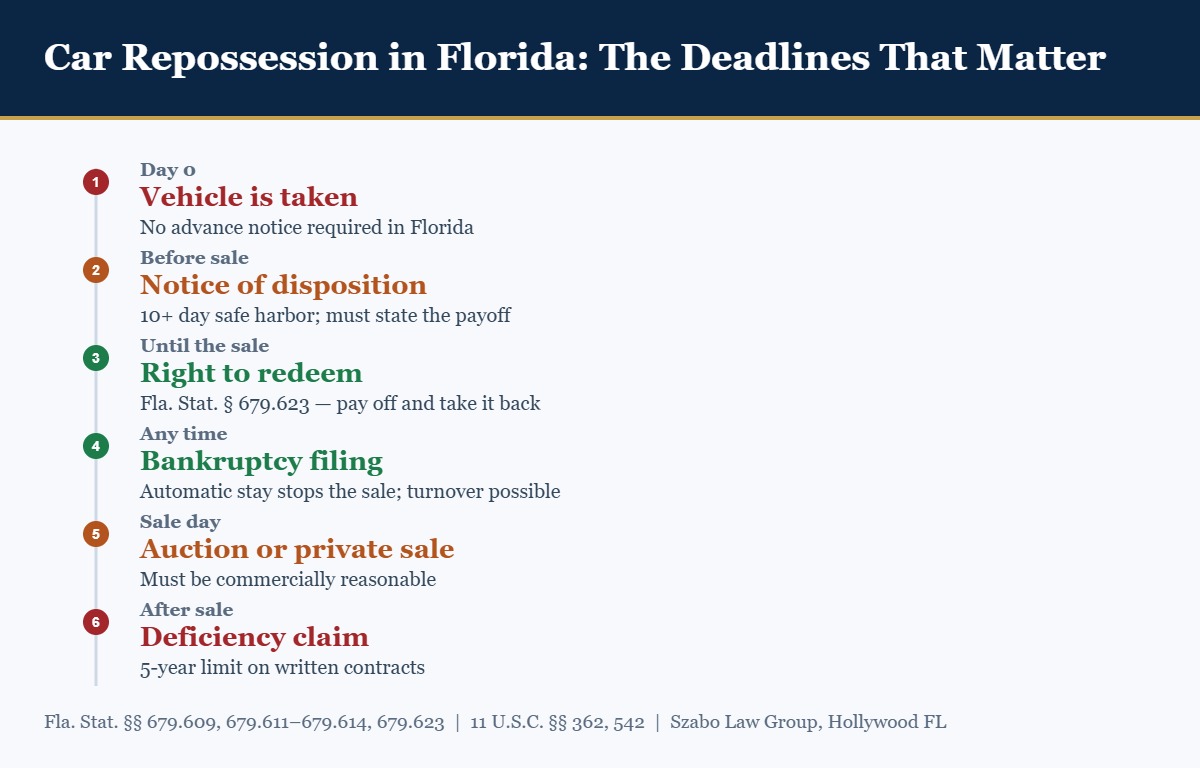
The notice of sale
Under Fla. Stat. §§ 679.611 through 679.614, the lender must send a reasonable authenticated notification of disposition before selling the vehicle. For a consumer transaction the notice has to describe the debt, explain that you may redeem, and give a telephone number you can call to learn the exact payoff. Fla. Stat. § 679.612 treats a notice sent ten or more days before the earliest sale date as timely as a matter of law. A missing, late or incomplete notice is one of the strongest defenses available.
Your belongings inside the car
The lender’s security interest covers the vehicle, not the child seat, tools or documents inside it. Those must be inventoried and made available to you. Ask in writing, keep the request, and do not let a storage-fee argument stop you from asking.
8 Ways to Stop a Car Repossession in Florida
1. Reinstate the loan before the sale
Roughly in the order most people should work through them when facing car repossession in Florida:
Many lenders will accept the past-due payments plus repossession and storage costs and simply return the vehicle. Reinstatement is a contractual courtesy rather than a statutory right in Florida, so it is worth asking early, in writing, and before the auction is scheduled.
2. Redeem the vehicle
Redemption is a statutory right. Under Fla. Stat. § 679.623 you may redeem the collateral by tendering the full amount owed plus the lender’s reasonable expenses, at any time before the lender sells, collects on or accepts the vehicle in satisfaction of the debt. It ends the car repossession in Florida outright — but the window closes at the sale, which is why the notice date matters so much.
3. Refinance or sell the car yourself before the auction
A private sale almost always brings more than a wholesale auction. If a family member can refinance, or a buyer can pay off the note directly, you both keep the equity and avoid the deficiency. Lenders frequently agree because they are made whole faster.
4. Challenge a breach of the peace
If the agent cut a lock, entered a closed garage, threatened anyone or refused to stop when told, the lawfulness of the taking is in play. That can mean damages, the return of the vehicle, or a lender suddenly willing to negotiate rather than litigate.
5. Challenge a defective notice or an unreasonable sale
If the notice never arrived, arrived late, or omitted the redemption information, the lender’s deficiency claim is vulnerable. The same is true if the vehicle sold far below book value in a sale that was not commercially reasonable.
6. Negotiate a voluntary surrender on written terms
If keeping the car is not realistic, surrendering it voluntarily can reduce fees — and gives you the chance to negotiate a written waiver of the deficiency. Never surrender on a verbal promise.
7. File Chapter 13 and keep the car
The automatic stay under 11 U.S.C. § 362 stops a car repossession in Florida the moment the petition is filed. Chapter 13 then lets you cure the arrears across a three- to five-year plan. If the car was purchased for personal use more than 910 days before filing, the loan can often be “crammed down” to the vehicle’s actual value, with interest reduced — frequently cutting the payment substantially. See our comparison of Chapter 7 vs Chapter 13 in Florida.
8. File Chapter 7 to kill the deficiency
Chapter 7 also triggers the stay, and it discharges the deficiency balance permanently. If you want to keep the vehicle, Chapter 7 offers redemption — paying the car’s present value in a lump sum — or reaffirmation, which keeps the original contract alive. If you are letting the car go, Chapter 7 ends the debt with it.
Special Cases: Leases, Title Loans and Buy Here Pay Here
Not every vehicle contract behaves the same way when a default happens.
- Leases. A lease is not a purchase, so there is no equity to protect and no redemption payoff in the usual sense. What you face instead is an early termination balance, which is often larger than people expect and is dischargeable in bankruptcy like any other unsecured claim.
- Title loans. Florida regulates title lenders separately, and the interest rates are high enough that balances grow quickly. The lender still has to follow the same UCC notice and sale rules before claiming a deficiency.
- Buy here pay here dealers. In-house financing frequently comes with GPS trackers and starter interrupt devices. Disabling a car remotely is not automatically lawful, and aggressive use of these tools has produced its own line of consumer claims.
Whatever the paperwork is called, the analysis in a car repossession in Florida case starts the same way: who holds the security interest, was the taking peaceful, and were the notices correct.
Getting the Vehicle Back After It Is Already Gone
Timing is everything. Before the sale, a bankruptcy filing brings the vehicle into the estate, and 11 U.S.C. § 542 allows a demand for turnover — the lender must give the car back, subject to providing adequate protection such as proof of insurance and plan payments. After the sale, the vehicle is gone and the fight becomes about money rather than the car.
That distinction is the single most important thing to understand about car repossession in Florida. The moment the auction closes, your best options close with it.
The Deficiency Judgment That Follows
Auction prices are low, fees are added, and the balance rarely disappears. This is the part of a car repossession in Florida that follows people for years. If the sale does not cover the loan, the lender can sue for the shortfall. Two points matter:
- The lender must show the sale was commercially reasonable and that the required notices went out. Defects here reduce or eliminate the claim.
- Suit on a written retail installment contract is generally subject to Florida’s five-year limitations period for written contracts.
A deficiency judgment is not the end of the story either — it is the beginning of collection. That is when creditors move to garnish wages or freeze bank accounts, and it is why so many people who lost a car end up filing bankruptcy a year later anyway.
What a Repossession Does to Your Credit
A repossession is reported as a serious derogatory event and stays on the credit report for seven years from the first delinquency that led to it. A voluntary surrender is reported too — the notion that handing the keys back looks better on a credit file is largely a myth, though it can reduce fees and improve your negotiating position on the deficiency.
What does far more long-term damage is the collection judgment that follows an unpaid deficiency, because it can be renewed for years and gives the creditor access to wages and bank accounts. That is why the right question after a car repossession in Florida is not only “can I get the car back” but also “how do I close out the balance for good.”
5 Mistakes That Cost People Their Car
- Hiding the vehicle. Concealing collateral can breach the contract and, in some circumstances, create criminal exposure. It also destroys any goodwill you might have had with the lender.
- Ignoring the notice of sale. That letter is the clock on your redemption right. Opening it late is the same as not opening it.
- Letting insurance lapse. It is a default in its own right, and forced-placed coverage inflates the balance fast.
- Relying on a verbal deal. “We’ll work with you” is not a modification. Get every arrangement in writing before you rely on it.
- Waiting for the auction date to call a lawyer. Nearly every remedy in a car repossession in Florida case is time-limited, and most of them expire at the sale.
How a Hollywood, FL Attorney Can Help
Most car repossession in Florida cases are won or lost on paperwork rather than argument.
The first step is reading the file: the contract, the default, the way the vehicle was taken, and every notice the lender sent or failed to send. From there the answer may be a demand letter, a redemption, a negotiated reinstatement, or a bankruptcy filing timed to stop the sale. What almost never works is waiting to see whether the lender calls back.
Szabo Law Group represents clients across Broward County from offices in Hollywood, Fort Lauderdale, Orlando and Jacksonville. If your vehicle has been taken — or you think it is about to be — call (954) 210-6054 or request a free consultation. You can also read about our repossession defense services in Hollywood, FL and our bankruptcy practice.
Frequently Asked Questions About Car Repossession in Florida
How many payments can I miss before repossession?
Legally, whatever your contract says — often a single missed payment. In practice most lenders act somewhere between 60 and 90 days past due, but there is no statutory grace period in Florida.
Can they take my car from my driveway at night?
Generally yes, if the driveway is open and nobody objects. Entering a closed garage or a locked gate is a different matter and is likely a breach of the peace.
Do I get notice before the car is taken?
No statutory notice is required beforehand. The required notice is the notification of disposition, which must be sent before the vehicle is sold.
Can I get my car back after repossession in Florida?
Yes, if you act before the sale — by redeeming, by negotiating a reinstatement, or by filing bankruptcy and demanding turnover. After the sale the vehicle itself is generally beyond reach.
Will I still owe money after they sell my car?
Usually. The auction price rarely covers the loan plus fees, and the lender can sue for the deficiency unless it is discharged in bankruptcy or defeated on the merits.
What happens to my belongings in the car?
They are yours. The lender must make personal property available to you; request it in writing and keep a copy.
Does filing bankruptcy stop a repossession that already happened?
It stops the sale and can compel turnover if the vehicle has not yet been sold. That is why the days immediately after a car repossession in Florida are the ones that matter most.
Key Takeaway
Car repossession in Florida moves fast because the law lets it. But speed cuts both ways: the lender has to follow the peace requirement going in and the notice requirements coming out, and you keep a statutory right to redeem right up to the auction. The people who recover their vehicles are almost always the ones who called someone in the first week.
Sources and further reading: Fla. Stat. § 679.609, Florida Senate and Fla. Stat. § 679.623 (right to redeem).
Disclaimer: This article provides general legal information about car repossession in Florida. It is not legal advice and does not create an attorney-client relationship. Contract terms and statutes vary and change; consult a licensed Florida attorney about your specific situation.