Last updated:
Almost every bankruptcy decision comes down to one question: liquidate or repay? That is the whole of Chapter 7 vs Chapter 13 — one chapter wipes out qualifying debt in about four months, the other reorganizes it into a court-supervised plan over three to five years. Choosing between them is not about which is “better.” It is about your income, your equity, and whether you are trying to keep something a creditor is about to take.
This guide from Szabo Law Group compares Chapter 7 vs Chapter 13 specifically for Florida filers, with the 2026 income and debt figures that actually decide eligibility.
What This Guide Covers
- Chapter 7 vs Chapter 13 at a glance
- What Chapter 7 actually does
- What Chapter 13 actually does
- Cost, timeline and credit impact
- The step-by-step timeline in each chapter
- 6 situations that decide it for you
- What both chapters do the day you file
- Debts neither chapter wipes out
- How often you can file
- Five myths about Chapter 7 vs Chapter 13
- Frequently asked questions
Chapter 7 vs Chapter 13 at a Glance
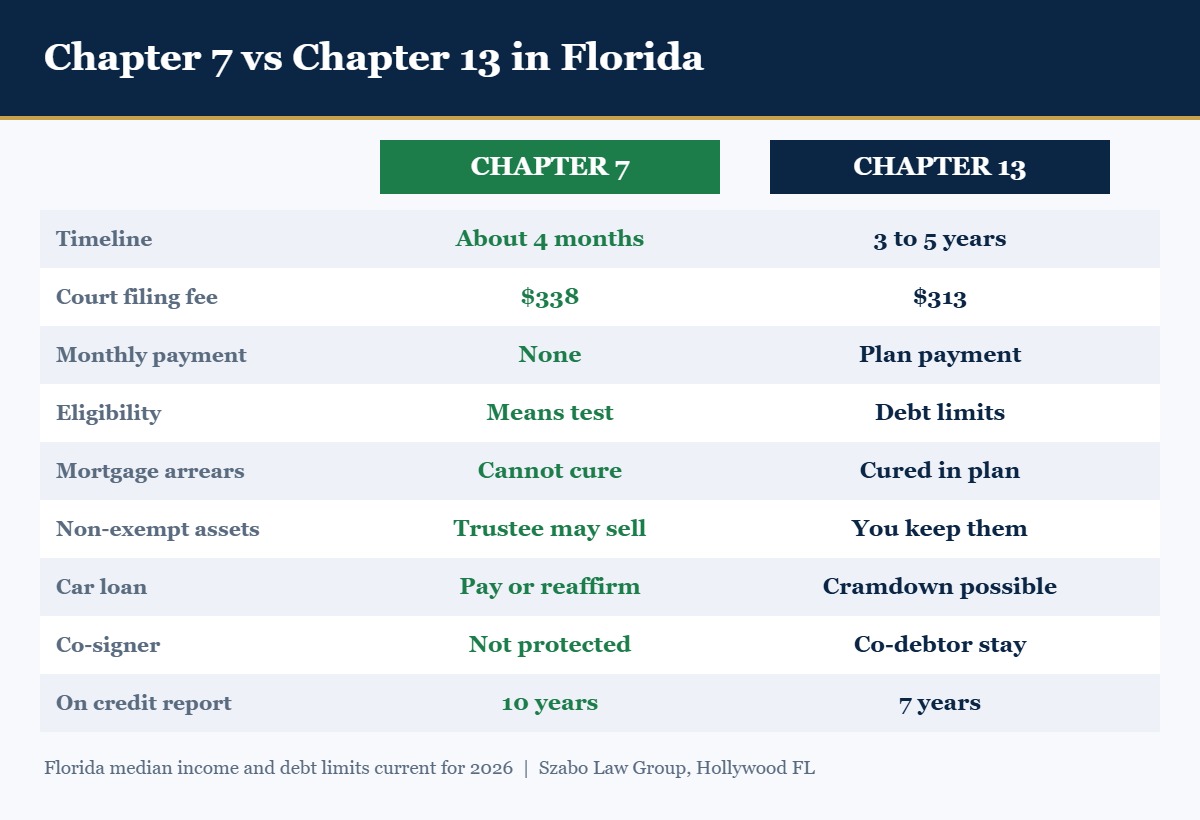
Here is how Chapter 7 vs Chapter 13 compares on the points that come up in almost every consultation:
| Chapter 7 | Chapter 13 | |
|---|---|---|
| What it is | Liquidation — debts discharged | Reorganization — debts repaid on a plan |
| How long | About 4 months | 3 to 5 years |
| Who qualifies | Income below the Florida median, or passes the means test | Regular income, within the debt limits |
| Court filing fee | $338 | $313 |
| Monthly payment | None | Yes — a plan payment to the trustee |
| Mortgage arrears | Cannot cure them | Cured over the life of the plan |
| Non-exempt property | Trustee may sell it | You keep it and pay its value into the plan |
| Credit report | 10 years from filing | 7 years from filing |
| Co-signers | Not protected | Co-debtor stay may protect them |
What Chapter 7 Actually Does
Half of the Chapter 7 vs Chapter 13 decision is simply understanding what each chapter is built to do.
Chapter 7 is the faster and cheaper of the two. A trustee reviews your assets, sells anything that is not exempt, distributes the proceeds, and the court discharges the remaining qualifying debt — credit cards, medical bills, personal loans, old utility balances, deficiency judgments after a repossession or foreclosure.
Who qualifies: the means test
Eligibility starts with your household income over the last six full calendar months, annualized, compared with the Florida median. If you are below the median, you qualify and the analysis usually ends there.
| Household size | Florida median family income |
|---|---|
| 1 | $69,876 |
| 2 | $86,523 |
| 3 | $97,540 |
| 4 | $114,761 |
| Each additional person | add $11,100 |
The U.S. Trustee Program updates these figures roughly every six months, so confirm the current numbers before relying on them. Being over the median is not disqualifying either — it just moves you to the second half of the means test, where allowed expenses, secured payments and priority debts are deducted. Plenty of over-median households still qualify for Chapter 7.
What you keep in Florida
Florida opted out of the federal exemption scheme, so state law controls. The headline protections are unusually strong:
- Homestead: unlimited in value, up to one-half acre inside a municipality or 160 acres outside one.
- Vehicle: $1,000 of equity, and a married couple filing together can stack their exemptions.
- Personal property: $1,000 — or $4,000 if you do not claim the homestead exemption.
- Retirement accounts: 401(k)s, IRAs and pensions are protected, in most cases without a dollar cap.
- Wages: the head of family exemption carries into bankruptcy, which is why filers who were already fighting a garnishment often qualify comfortably.
What Chapter 7 cannot do
It cannot cure a mortgage default, stop a foreclosure permanently, or force a lender to take payments. It only delays those things through the automatic stay. That single limitation is the most common reason the Chapter 7 vs Chapter 13 question resolves in favor of Chapter 13.
What Chapter 13 Actually Does
Chapter 13 is a repayment plan supervised by a trustee and confirmed by a judge. You keep everything, including non-exempt assets, and pay your creditors what your budget allows for three years (below-median income) or five years (above-median). Whatever unsecured balance remains at the end is discharged.
Who qualifies: income and debt limits
You need regular income — wages, self-employment, Social Security, rental income, even reliable family support. You also have to fit inside the statutory debt limits, which are separate rather than combined:
- Unsecured debts must be less than $526,700
- Secured debts must be less than $1,580,125
Those amounts took effect April 1, 2025 and hold until the next adjustment on April 1, 2028. Exceeding either one on its own makes you ineligible, which pushes a small number of filers toward Chapter 11.
What Chapter 13 can do that Chapter 7 cannot
- Cure mortgage arrears. Months of missed payments are spread across the plan while you resume regular payments — the reliable way to stop a foreclosure in Florida and keep the house.
- Strip a wholly underwater second mortgage. If the first mortgage exceeds the home’s value, a second or third can sometimes be reclassified as unsecured and discharged.
- Cram down a car loan. A vehicle financed more than 910 days before filing can be repaid at the car’s value rather than the loan balance, often at a lower interest rate.
- Spread out priority debt. Recent income taxes and support arrears must be paid in full — but over years, without collection pressure.
- Protect a co-signer. The co-debtor stay shields a relative who co-signed a consumer loan, which Chapter 7 does not do.
- Keep non-exempt property. You pay its value into the plan instead of handing it to a trustee.
The plan payment
The payment is not negotiable in the ordinary sense; it is the product of a budget analysis. It must cover secured arrears, priority debts, trustee fees and at least what unsecured creditors would have received in a Chapter 7 liquidation. Missing payments is the main reason Chapter 13 cases fail, so a plan that is realistic on day one matters more than a plan that looks impressive. This is where the Chapter 7 vs Chapter 13 comparison stops being theoretical and becomes a budget question.
Chapter 7 vs Chapter 13: Cost, Timeline and Credit
On paper, Chapter 7 vs Chapter 13 looks like a simple cost comparison. Court filing fees are $338 for Chapter 7 and $313 for Chapter 13. Attorney fees differ more: Chapter 7 is usually a flat fee paid before filing, while most Chapter 13 fees are built into the plan and paid over time — which is why Chapter 13 often costs less out of pocket on day one, and more in total.
On credit, the difference is smaller than people expect. A Chapter 7 stays on the report for ten years from filing and a Chapter 13 for seven, but scores usually begin recovering within a year in either case, because the underlying delinquencies stop accumulating. Filers frequently see secured card offers within months and qualify for FHA financing two years after a Chapter 7 discharge, or one year into a Chapter 13 plan with court approval.
Chapter 7 vs Chapter 13: The Step-by-Step Timeline
The paperwork is nearly identical; what differs is everything after the filing date.
- Before filing: gather six months of pay stubs, two years of tax returns, and complete the credit counseling course. Both chapters require all three.
- Day 0: the petition is filed, the automatic stay takes effect, and a case number issues within minutes.
- Day 21–40: the meeting of creditors — a short, sworn question-and-answer session with the trustee. In practice it lasts a few minutes in both chapters.
- Chapter 13 only, day 30: the first plan payment is due, even before the plan is confirmed.
- Chapter 13 only, month 2–4: the confirmation hearing, where the judge approves the plan or sends it back for changes.
- Chapter 7, about month 4: discharge. The case usually closes within weeks.
- Chapter 13, year 3 to 5: discharge after the final plan payment and the financial management course.
That gap — four months against several years — is the practical heart of Chapter 7 vs Chapter 13, and it is why the choice is worth getting right the first time.
6 Situations That Decide Chapter 7 vs Chapter 13 for You
- You are behind on a mortgage and want to keep the house. Chapter 13. It is the only chapter that forces a lender to accept catch-up payments.
- Your income is above the Florida median and the means test does not clear. Chapter 13, at least until the six-month income lookback improves.
- You have significant non-exempt equity — a rental, a boat, a second vehicle. Chapter 13, unless you are willing to let a trustee sell it.
- You owe recent income taxes that cannot be discharged. Chapter 13 spreads them over the plan, interest-free in many cases.
- Your debt is unsecured, your income is modest, and everything you own is exempt. Chapter 7 — the classic case, done in about four months.
- A garnishment is already taking your paycheck and you have no house to save. Usually Chapter 7. See our guide to stopping a wage garnishment in Florida.
What Both Chapters Do the Day You File
Whatever you decide in the Chapter 7 vs Chapter 13 analysis, the automatic stay under 11 U.S.C. § 362 takes effect the moment the petition is docketed. Wage garnishments stop. Foreclosure sales are cancelled. Repossession efforts halt, which is why filing is often the fastest way to stop a vehicle repossession. Collection calls, lawsuits and bank levies all have to stop, and creditors who ignore the stay can be sanctioned.
Both chapters also require the same two counseling courses — credit counseling before filing and a financial management course before discharge — and both require complete schedules of income, expenses, assets and debts signed under penalty of perjury. In other words, the Chapter 7 vs Chapter 13 choice changes what happens next, not how you get to the courthouse.
Debts Neither Chapter Wipes Out
Some obligations survive the discharge no matter how the Chapter 7 vs Chapter 13 question is answered:
- Child support and alimony
- Most recent income taxes, and any unfiled tax years
- Student loans, absent a separate undue-hardship showing
- Court fines, restitution and most criminal penalties
- Debts from fraud, willful injury or drunk driving
Chapter 13 does not discharge these either — but it does something Chapter 7 cannot: it forces them into an orderly, protected repayment schedule while collection stays frozen.
How Often You Can File
Prior filings can settle the Chapter 7 vs Chapter 13 question for you, because the waiting periods differ by chapter:
- Chapter 7 after Chapter 7: 8 years between filing dates.
- Chapter 7 after Chapter 13: 6 years, waived if the earlier plan paid unsecured creditors in full or nearly so.
- Chapter 13 after Chapter 7: 4 years.
- Chapter 13 after Chapter 13: 2 years.
These windows govern the discharge, not the filing. A repeat case filed too early still triggers the automatic stay in most circumstances, which is occasionally the point.
Five Myths About Chapter 7 vs Chapter 13
- “Bankruptcy takes everything.” In the overwhelming majority of Florida Chapter 7 cases the trustee sells nothing at all, because state exemptions cover the filer’s property.
- “Chapter 13 means paying back every dollar.” Unsecured creditors frequently receive only a small percentage; the rest is discharged at the end of the plan.
- “You can never get credit again.” Auto financing is commonly available within a year of discharge, and mortgage programs open two to three years out.
- “Filing is public and everyone will know.” Cases are public records, but nobody is notified except your listed creditors — employers are not told in a consumer case.
- “You have to be broke to file.” The Chapter 7 vs Chapter 13 test is about income against expenses and exemptions, not about hitting zero.
Can You Switch Chapters Later?
Yes, and it happens routinely. A Chapter 13 debtor who loses a job can convert to Chapter 7; a Chapter 7 filer who discovers non-exempt equity can convert to Chapter 13 to protect it. Conversion is a right in most cases, not a favor — which takes some of the pressure off the initial Chapter 7 vs Chapter 13 decision.
How a Hollywood, FL Bankruptcy Attorney Decides
Chapter 7 vs Chapter 13 is decided on paper long before it is argued. The analysis is mechanical before it is strategic: run the six-month income lookback, apply the means test, value every asset against Florida exemptions, total the secured arrears, and check the debt limits. Only then does judgment enter — whether the plan payment is sustainable, whether an asset is worth protecting, whether waiting two months would change the income calculation entirely.
Szabo Law Group represents filers across Broward County from offices in Hollywood, Fort Lauderdale, Orlando and Jacksonville. For a free case review, call (954) 210-6054 or request a consultation. You can also read more about our bankruptcy services in Hollywood, FL.
Frequently Asked Questions
Is Chapter 7 or Chapter 13 better?
Neither is better in the abstract, and the Chapter 7 vs Chapter 13 answer follows the numbers rather than a preference. Chapter 7 is faster and cheaper when your income is modest and your property is exempt. Chapter 13 is the right answer when you need to cure arrears, protect non-exempt equity, or your income is too high to pass the means test.
Will I lose my house in Chapter 7?
Usually not. Florida’s homestead exemption is unlimited in value, so equity alone does not put the house at risk. What matters is whether the mortgage is current — Chapter 7 cannot fix a default.
Can I file Chapter 7 if I make good money?
Often, yes. The means test looks at income minus allowed expenses, so a large mortgage, childcare, support obligations or high medical costs can bring an above-median household back under the line.
How much does Chapter 13 cost each month?
It depends entirely on your budget and what has to be paid through the plan. Payments range from under two hundred dollars to several thousand, and the plan cannot be confirmed unless the court finds it feasible.
Does my spouse have to file with me?
No. You can file individually, and it is sometimes preferable — for example, when only one spouse carries the debt, or when filing separately preserves exemptions. Both incomes are still counted in the means test if you live together.
What happens to my car?
In Chapter 7 you keep it if the equity is exempt and you stay current or reaffirm the loan. In Chapter 13 you keep it as long as the plan pays what is owed, potentially crammed down to the vehicle’s value.
Can I convert from Chapter 13 to Chapter 7?
Yes. Debtors who lose income mid-plan convert regularly, and the earlier filing date is preserved for many purposes.
Key Takeaway
Chapter 7 vs Chapter 13 is a question of arithmetic first and strategy second. Run the income lookback, price your assets against Florida’s exemptions, and add up what has to be cured. In most Florida cases the numbers point clearly to one chapter — and the filers who get it wrong are usually the ones who guessed instead of calculating.
Sources and further reading: U.S. Courts, Chapter 13 Bankruptcy Basics and U.S. Trustee Program means testing data.
Disclaimer: This article provides general legal information about Chapter 7 vs Chapter 13 bankruptcy in Florida. It is not legal advice and does not create an attorney-client relationship. Income figures, debt limits and fees change; confirm current amounts with a licensed Florida attorney before filing.