Last updated:
If a creditor is taking money straight out of your paycheck, you are not out of options. Wage garnishment in Florida can be stopped — and in some cases undone — but only if you act inside a very short legal window. Florida gives working families one of the strongest paycheck protections in the country, and federal bankruptcy law can freeze a wage garnishment the same hour a case is filed.
This guide from Szabo Law Group explains how wage garnishment works in Florida, how much of your paycheck a creditor may legally take, and seven practical ways to stop a wage garnishment before your next payday.
What This Guide Covers
- What wage garnishment in Florida actually is
- How much of your paycheck a creditor can take
- 7 ways to stop a wage garnishment in Florida
- The 20-day deadline you cannot afford to miss
- Wage garnishment vs. bank account garnishment
- Child support, student loan and IRS garnishments
- What your employer must do — and can never do
- Frequently asked questions
What Is Wage Garnishment in Florida?
Wage garnishment is a court-ordered process that lets a creditor collect a debt directly from your employer, before your paycheck ever reaches you. In Florida the legal instrument is called a writ of garnishment, and the procedure is set out in Chapter 77 of the Florida Statutes. Your employer becomes the “garnishee” and is legally obligated to withhold — an employer who ignores a writ can be held liable for the entire judgment.
A creditor usually needs a judgment first
With ordinary consumer debt — credit cards, medical bills, personal loans, car loan deficiency balances — no wage garnishment is possible until the creditor has sued you and won a money judgment. That means a summons and complaint should have reached you first. In practice, a large share of Florida garnishments grow out of a default judgment entered because the debtor never answered the lawsuit, or never actually received it at the address on file.
A few categories of debt skip the courtroom entirely. Federal student loans, unpaid federal taxes and child support obligations can be collected through administrative wage garnishment, with no judge signing a judgment against you.
Florida uses a “continuing writ”
Once a writ is served on your employer, it does not expire after a single payday. Florida allows a continuing writ of garnishment, which stays in force pay period after pay period until the judgment is satisfied, you leave the job, or a court dissolves the writ. The creditor never has to refile. This is exactly why waiting is never a strategy — the wage garnishment simply repeats itself until something legally stops it.
How long a Florida judgment lasts
A Florida money judgment is enforceable for 20 years and can be re-recorded, so an old debt you had forgotten about can resurface as a wage garnishment a decade later. Interest accrues the entire time at the statutory rate, which is why balances often look far larger than the original debt.
How Much of Your Paycheck Can a Creditor Take?
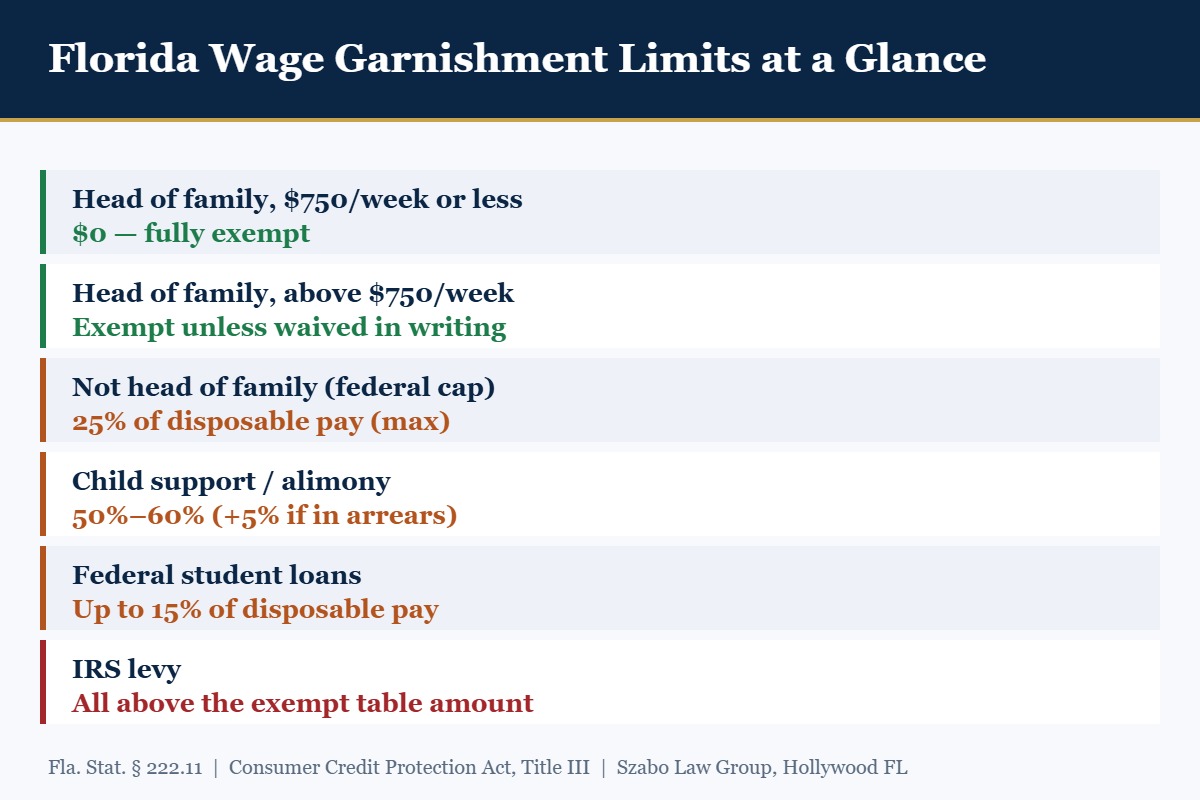
Two sets of rules apply simultaneously: the federal cap under Title III of the Consumer Credit Protection Act, and Florida’s own exemption in Fla. Stat. § 222.11. Whichever protects you more is the one that controls the wage garnishment.
| Your situation | Maximum subject to wage garnishment |
|---|---|
| Head of family, disposable earnings of $750/week or less | $0 — fully exempt |
| Head of family, earning more than $750/week | Still exempt, unless you signed a written waiver agreeing to the garnishment |
| Not head of family (federal cap applies) | The lesser of 25% of disposable earnings, or the amount above 30× the federal minimum wage ($217.50/week) |
| Child support or alimony | 50%–60% of disposable earnings, plus 5% if more than 12 weeks in arrears |
| Federal student loans | Up to 15% of disposable pay |
| IRS tax levy | Everything above a statutory exempt amount based on filing status and dependents |
“Disposable earnings” means what remains after legally required deductions — federal income tax, Social Security and Medicare. Voluntary deductions such as a 401(k) contribution, union dues or a gym membership do not reduce the amount exposed to wage garnishment.
A quick example
Take a Hollywood, Florida warehouse supervisor earning $1,040 gross per week, with $190 in required deductions. Disposable earnings are $850. If she is not head of family, the creditor may take the lesser of 25% ($212.50) or the amount above $217.50 ($632.50) — so $212.50 per week, roughly $11,000 a year. If she supports a child or a disabled parent and qualifies as head of family, the correct answer is $0, because she never signed a waiver. Same paycheck, completely different outcome — decided entirely by a form filed with the clerk.
7 Ways to Stop a Wage Garnishment in Florida
Here are the realistic options, roughly in the order most Florida debtors should evaluate them.
1. Claim the head of family exemption
This is Florida’s most powerful protection and the most common way to defeat a wage garnishment outright. Under Fla. Stat. § 222.11, if you provide more than one half of the support for a child or other dependent, you qualify as head of family. If you qualify and your disposable earnings are $750 a week or less, 100% of your wages are exempt and the creditor collects nothing.
Two points people routinely get wrong:
- The dependent does not have to be a minor child. An elderly parent, a disabled adult child or a non-working spouse can qualify you — the test is broader than the IRS definition of a dependent.
- Earning above $750 a week does not automatically cost you the protection. Those earnings remain exempt from wage garnishment unless you signed a separate written agreement waiving the exemption, language often buried in loan or credit card paperwork.
2. File a claim of exemption — within 20 days
The exemption is not automatic; it must be asserted. When the writ is served you should receive a notice together with a Claim of Exemption and Request for Hearing form, and you have 20 days from receiving that notice to file it with the clerk of court. Miss the window and the withheld money is released to the creditor.
Once you file, the creditor has 8 business days (hand delivery) or 14 business days (service by mail) to file a sworn written statement contesting your claim. If the creditor does not respond, the court dissolves the writ and the wage garnishment ends. If it does respond, the court schedules a hearing where you present pay stubs, tax returns and proof of support.
3. Attack the underlying judgment
If you were never properly served with the original lawsuit, if the debt belongs to someone else, if the statute of limitations had already expired, or if the balance includes fees the contract never authorized, the judgment behind the wage garnishment may be vulnerable. A motion to vacate a default judgment — or to quash defective service of process — removes the legal foundation for the writ entirely. Deadlines here are strict and fact-specific, so this is not a do-it-yourself project.
4. Negotiate a settlement or payment plan
Creditors know garnishment is slow, administratively expensive and easily disrupted by a bankruptcy filing. Many will accept a lump-sum settlement at a meaningful discount, or a voluntary monthly payment, in exchange for releasing the writ. Put everything in writing, and make sure the agreement expressly requires the creditor to file a release of the wage garnishment with the court — not merely to “stop collecting.”
5. File Chapter 7 bankruptcy
The moment a bankruptcy petition is filed, 11 U.S.C. § 362 imposes an automatic stay. Wage garnishment must stop immediately; your attorney notifies the creditor, the court and your employer’s payroll department the same day. A successful Chapter 7 case then wipes out the underlying debt in roughly four months, so the garnishment can never restart. If more than $600 was taken in the 90 days before filing, that money may also be recoverable as a preferential transfer.
6. File Chapter 13 bankruptcy
If your income is too high for Chapter 7, or you are simultaneously fighting to save a house or a vehicle, Chapter 13 stops the wage garnishment with the same automatic stay and folds the debt into one court-supervised plan lasting three to five years. Unsecured creditors receive only what your budget genuinely allows, and the remaining balance is discharged at the end. If a mortgage is also behind, the same plan can stop a foreclosure in Florida and cure the arrears over the life of the plan. Chapter 13 pairs naturally with foreclosure defense and with efforts to stop a vehicle repossession.
7. Seek a hardship modification
For the garnishments bankruptcy does not reach — most notably child support — the correct route is a motion to modify the underlying order based on a real change in circumstances such as job loss, disability or a new dependent. Federal student loan garnishments have their own administrative hardship hearing, which can suspend collection while an income-driven repayment plan is set up.
The Deadlines That Decide Your Case
- Day 0: the writ is served on your employer, who must begin withholding and hold the disputed funds.
- Within 20 days of receiving the notice: file your Claim of Exemption and Request for Hearing.
- 8–14 business days later: if the creditor fails to contest your claim, the writ is dissolved automatically.
- Any time: a bankruptcy filing triggers the automatic stay, which halts the wage garnishment no matter how far along the process has gone.
If you have already missed the 20-day deadline, do not assume it is over. Courts can consider late claims in some circumstances, and bankruptcy remains available at any stage — even after months of withholding.
Wage Garnishment vs. Bank Account Garnishment
Creditors frequently pursue both at once. The good news is that Florida’s exemption follows the money: wages belonging to a head of family that are directly deposited and remain traceable keep their exempt character for six months after deposit. Social Security, SSI, veterans’ benefits, workers’ compensation and most retirement income are separately protected as well.
The practical problem is proof. Once exempt wages are mixed with other funds, tracing becomes an accounting exercise. Keeping protected income in a dedicated account — and not the account used for everything else — makes a claim of exemption dramatically easier to win.
Child Support, Student Loans and Tax Garnishments
Florida’s head of family exemption does not cover every debt, and neither does a bankruptcy discharge.
- Child support and alimony: the head of family exemption does not apply, and the automatic stay does not stop an income deduction order. Relief comes from modifying the support order itself.
- Federal student loans: up to 15% of disposable pay can be taken administratively. Bankruptcy’s automatic stay pauses that wage garnishment while the case is open, and loan rehabilitation, consolidation or an income-driven plan usually ends it permanently.
- IRS levies: the exempt amount comes from federal tax tables rather than Florida law. An installment agreement, currently-not-collectible status or an offer in compromise is normally the fastest path to a release.
- Court fines and most recent tax debt: these generally survive a Chapter 7 discharge, although Chapter 13 can stretch repayment over several years and stop the garnishment in the meantime.
What Your Employer Must Do — and Can Never Do
Your employer has no discretion once a writ arrives: it must answer the writ within 20 days, begin withholding, and continue until the court says otherwise. Payroll may also deduct a small statutory processing fee.
What your employer may not do is fire you over a single debt. Title III of the Consumer Credit Protection Act makes termination illegal when earnings are subject to wage garnishment for any one debt, regardless of how many notices arrive for that same obligation. That protection weakens once garnishments for two or more separate debts are in force — another reason to resolve the first one quickly rather than letting a second creditor pile on.
How a Hollywood, FL Debt Relief Attorney Can Help
Garnishment cases are won on paperwork and deadlines, not arguments. An attorney can pull the court file to confirm the judgment is even valid, prepare and file the claim of exemption correctly the first time, argue the head of family question at the hearing with the right documentation, and — where the overall debt load justifies it — file the bankruptcy petition that ends the wage garnishment the same day.
Szabo Law Group represents clients throughout Broward County from offices in Hollywood, Fort Lauderdale, Orlando and Jacksonville. If your paycheck is already being taken, call (954) 361-9091 or request a free consultation. You can also read more about our wage garnishment defense services in Hollywood, FL.
Frequently Asked Questions About Wage Garnishment in Florida
How fast can wage garnishment be stopped in Florida?
A bankruptcy filing stops it the same day, because the automatic stay takes effect the moment the petition is docketed. A claim of exemption typically resolves in two to four weeks, depending on whether the creditor contests it and how quickly the court sets a hearing.
Can a creditor start wage garnishment without notifying me?
No. Florida law requires the creditor to serve you with a copy of the writ, the garnishee’s answer and a notice explaining your right to claim exemptions. A failure to deliver that notice is itself grounds to dissolve the writ.
Does bankruptcy stop every type of wage garnishment?
Almost all of them. The automatic stay halts garnishment for credit cards, medical debt, personal loans, judgments and deficiency balances. Domestic support obligations are the principal exception and continue during the case.
Can I recover money that was already garnished?
Sometimes. If more than $600 was taken in the 90 days before a bankruptcy filing, that transfer may be recoverable as a preference. Funds already withheld but not yet turned over to the creditor are also frequently returned once the writ is dissolved.
What happens if I have two jobs?
Each employer can be served with a separate writ, and the federal cap is applied per employer. The head of family exemption, by contrast, is evaluated against your total disposable earnings — which is why the analysis is worth doing carefully before you respond.
Do I qualify as head of family if my spouse also works?
Possibly. The test is whether you provide more than half the support for a dependent. Only one spouse may claim the status for the same dependents, so if both of you face wage garnishment, the exemption should be claimed by whoever genuinely provides the majority of support.
Can I be garnished for a debt from another state?
Yes. An out-of-state judgment can be domesticated in Florida and enforced here, but Florida exemption law then governs the wage garnishment — including the head of family exemption.
Key Takeaway
Florida gives working families genuinely strong tools against wage garnishment, but every one of them runs on a clock. Whether the right move is a claim of exemption, a challenge to the judgment, a negotiated release or a bankruptcy filing, the fastest way to stop a wage garnishment in Florida is to act before the next payday — not after.
Sources and further reading: U.S. Department of Labor Fact Sheet #30 on federal garnishment limits and Fla. Stat. § 222.11, Florida Senate.
Disclaimer: This article provides general legal information about wage garnishment in Florida. It is not legal advice and does not create an attorney-client relationship. Statutory amounts and procedures change over time; consult a licensed Florida attorney about your specific circumstances.