“If I file bankruptcy, will it cost me my green card?” It is one of the most common questions in a firm that practices both areas, and the short answer is reassuring: bankruptcy and immigration law barely intersect. Filing is a civil federal court proceeding. It is not a crime, it is not a ground of inadmissibility, and it is not listed anywhere as a bar to naturalization.
That said, “barely” is not “never” — and the places where bankruptcy and immigration do touch are worth understanding before you file. This guide from Szabo Law Group, which handles both bankruptcy and immigration matters, walks through what actually matters.
What This Guide Covers
- Can a non-citizen file bankruptcy?
- Does filing affect your status or pending application?
- Naturalization and good moral character
- Public charge — what it actually covers in 2026
- The real risk: bankruptcy fraud
- What bankruptcy does and does not erase
- Practical questions non-citizen filers ask
- Chapter 7 or Chapter 13 for a non-citizen?
- Five myths
- The I-864 affidavit of support
- Who actually files, and why
- Frequently asked questions
Can a Non-Citizen File Bankruptcy?
Yes — and this is where most bankruptcy and immigration worries end. The eligibility rule is 11 U.S.C. § 109(a), and it is short: a debtor must be a “person that resides or has a domicile, a place of business, or property in the United States.” Citizenship appears nowhere in it. Lawful status appears nowhere in it either.
In practice that means lawful permanent residents, visa holders, asylees, refugees, DACA recipients and undocumented individuals with a U.S. residence or property can all file. The bankruptcy court is not an immigration tribunal, and the intersection of bankruptcy and immigration begins and ends with what each system independently requires.
What the court does ask for
The petition asks for identifying information, and Official Form 121 accommodates filers with no Social Security number and no ITIN. Providing a number that is not yours is a federal crime and is exactly the kind of act that turns a routine filing into an immigration problem. If you do not have a number, say so.
Does Filing Affect Your Status or a Pending Application?
Filing bankruptcy is not a ground of inadmissibility under INA § 212 and not a ground of deportability under INA § 237. It is not a crime. It does not appear on the list of things that make someone removable, and USCIS does not deny a green card because an applicant used a federal statute Congress wrote for exactly this purpose.
What people are usually worried about, when they worry about bankruptcy and immigration together, is one of three things: whether it looks bad, whether it counts as a public charge issue, and whether it affects good moral character. Each is addressed below, and none of them says what the fear assumes.
Naturalization and Good Moral Character
This is the question that drives most bankruptcy and immigration consultations.
To naturalize you must show good moral character, defined at 8 C.F.R. § 316.10. Read the regulation and you will notice something: bankruptcy is not in it. Not as a bar, not as a discretionary negative factor, not at all.
What the regulation and USCIS policy do care about, in the financial sphere, is conduct:
- Willful failure to support dependents. Unpaid court-ordered child support is a recognized negative factor — and note that support obligations are not dischargeable in bankruptcy anyway.
- False testimony under oath given to obtain an immigration benefit.
- Tax obligations handled dishonestly. Owing taxes is not the problem; concealing income or ignoring a filing obligation is.
- Fraud of any kind, including fraud committed in a bankruptcy case.
Seen that way, the relationship between bankruptcy and immigration flips: a debtor who resolves debts lawfully and pays support obligations through a Chapter 13 plan is in a better position on good moral character than one who lets judgments and arrears accumulate.
Public Charge — What It Actually Covers in 2026
Of everything in bankruptcy and immigration, this is the area where the law has genuinely moved, so the date you read this matters.
The 2022 DHS rule defined a public charge narrowly: someone likely to become primarily dependent on government cash assistance for income maintenance, or on long-term institutionalization at government expense. DHS has since rescinded that rule, and a replacement takes effect September 18, 2026, returning the analysis to a broader totality-of-the-circumstances review of the statutory factors — age, health, family status, financial status and assets, and education and skills.
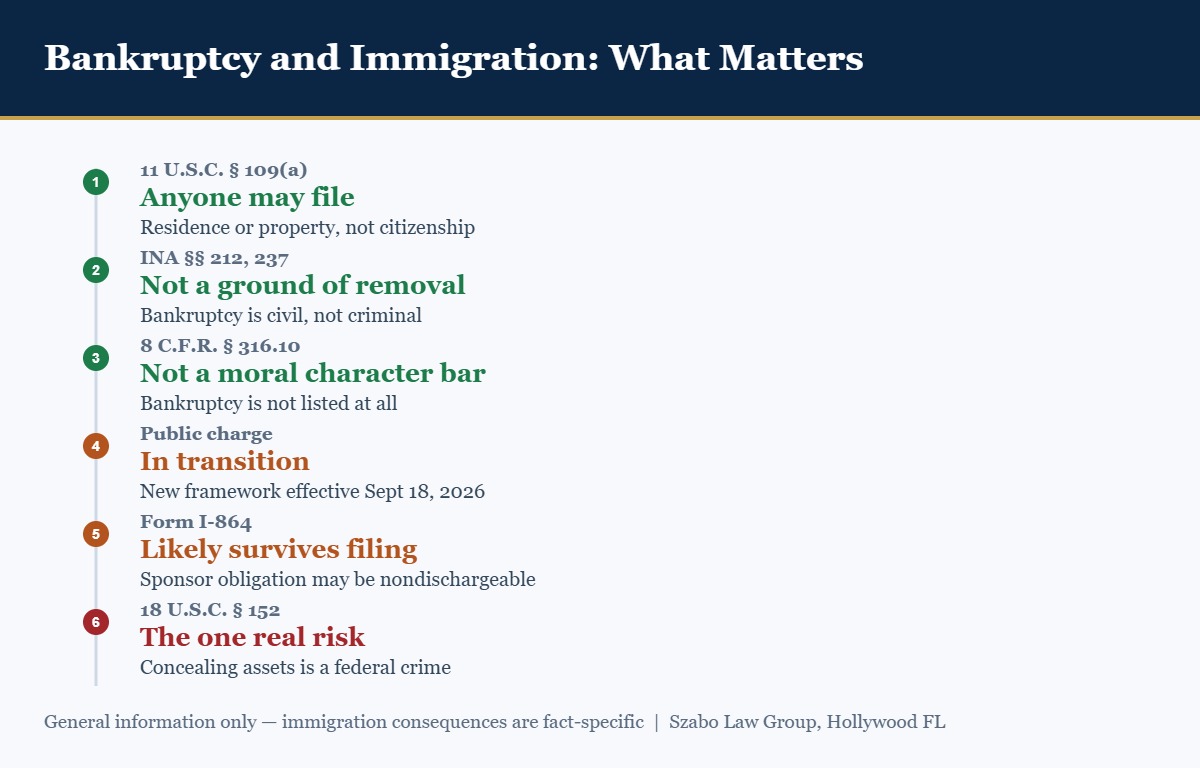
Two points to hold onto. First, neither the old rule nor the new framework lists bankruptcy or unsecured consumer debt as a public charge factor. Second, “financial status” is one of the statutory factors, which is precisely why the honest answer to a public charge question is that it depends on your whole picture, not on whether you once filed a Chapter 7. Because this rule is in transition, anyone with a pending or upcoming application should ask an immigration attorney how the timing applies to their case specifically.
The Real Risk in Bankruptcy and Immigration: Fraud
Everything else in bankruptcy and immigration is reassuring. This part is not, and it deserves to be read carefully.
Here is the one place where a bankruptcy case can create genuine immigration exposure, and it has nothing to do with being in debt.
Under 18 U.S.C. § 152 it is a federal crime to knowingly and fraudulently conceal assets from a bankruptcy trustee, to make a false oath or account in a case, or to present a false claim. A conviction for that kind of conduct is a criminal fraud offense, and criminal fraud offenses can be treated as crimes involving moral turpitude — which carries real inadmissibility, deportability and good-moral-character consequences.
The practical lesson is unglamorous and absolute: disclose everything. Every account, every vehicle, every transfer to a relative, every business interest, every expected inheritance. Bankruptcy and immigration problems arise from concealment, not from insolvency.
What Bankruptcy Does and Does Not Erase
The list is the same for every filer, and two entries matter especially in a bankruptcy and immigration context.
- Discharged: credit cards, medical bills, personal loans, most judgments, deficiency balances after a repossession or foreclosure, old utility accounts.
- Not discharged: child support and alimony, most recent income taxes, student loans absent an undue hardship showing, court fines and restitution, and debts incurred by fraud.
- Probably not discharged: an I-864 sponsorship obligation, at least where the sponsored person is a spouse.
Notice that the two categories immigration officers actually look at — support obligations and anything touching fraud — are precisely the ones bankruptcy does not wipe out. That alignment is not a coincidence, and it is why filing honestly rarely creates a problem.
Practical Questions Non-Citizen Filers Ask
These come up in nearly every bankruptcy and immigration consultation:
Is my case public?
Bankruptcy filings are federal court records and are publicly accessible, with Social Security numbers redacted. They are not published or announced, and no notice is sent to anyone other than the creditors and parties you list.
Who actually gets notified?
Your listed creditors, the trustee, and the court. The trustee’s job is to administer assets, not to investigate immigration matters.
Can I bring an interpreter?
Yes. The meeting of creditors is conducted in English, and interpreter services are available through the court and the U.S. Trustee Program. Arrange it in advance rather than bringing a family member and hoping.
Do I need to be present?
You must attend the meeting of creditors, which in most districts is now conducted by video or telephone. Missing it is the fastest way to have a case dismissed.
Chapter 7 or Chapter 13 for a Non-Citizen Filer?
The chapter analysis is the same regardless of status, but two considerations come up more often in bankruptcy and immigration cases.
- Support arrears. Child support and alimony cannot be discharged in either chapter. Chapter 13 lets you cure the arrears on a protected schedule — which is worth noting given how good moral character treats unpaid support.
- Sponsor obligations. If you signed an I-864, assume the obligation survives. A Chapter 13 budget that accounts for it is more realistic than a Chapter 7 that ignores it.
- Property abroad. Assets outside the United States are still property of the estate and must be disclosed. Foreign real estate, accounts and business interests all go on the schedules.
- Travel. Neither chapter restricts international travel. A Chapter 13 debtor should simply keep plan payments current while away.
The I-864 Affidavit of Support
This is the most important technical point in any bankruptcy and immigration conversation, and it surprises people.
If you signed a Form I-864 affidavit of support to sponsor an immigrant, that promise is a contract enforceable by the sponsored person. In Erler v. Erler, 824 F.3d 1173 (9th Cir. 2016), the court treated a sponsor’s I-864 obligation to a spouse as akin to a domestic support obligation — which would make it nondischargeable under 11 U.S.C. § 523(a)(5).
Florida sits in the Eleventh Circuit, which has not squarely decided the question, so the safe planning assumption is that an I-864 obligation survives bankruptcy. If you are a sponsor considering filing, this needs to be analyzed before the petition, not after.
Florida Homestead for Non-Citizens
Florida’s constitutional homestead exemption is not limited to citizens. What matters is whether the property is your permanent residence, and Florida courts have extended protection to non-citizens, including through a dependent child who is a citizen or lawful permanent resident.
The federal overlay still applies: under 11 U.S.C. § 522(b)(3)(A) you must have been domiciled in Florida for 730 days before filing to use Florida’s exemption list at all. See our guide to Florida bankruptcy exemptions for the full picture of what is protected.
Who Actually Files, and Why
The households that come through the door with bankruptcy and immigration questions tend to look alike. A green card holder whose small business closed. A visa holder facing hospital bills after an uninsured emergency. A naturalization applicant carrying a decade-old judgment that keeps growing at eight percent a year. A sponsor whose own finances collapsed after the person they sponsored arrived.
In every one of those situations the debt problem is the urgent one and the immigration process is the long one — which is exactly why the two get handled together. Leaving a judgment in place so that a garnishment can quietly drain wages for years is not a neutral choice; it makes the financial picture worse over precisely the period when stability matters most.
5 Rules for Non-Citizen Filers
If you remember nothing else about bankruptcy and immigration, remember these:
- Tell both lawyers about the other case. Your bankruptcy attorney needs to know about a pending petition or naturalization application; your immigration attorney needs to know you are considering filing.
- Never use a number that is not yours. No exceptions, no shortcuts, no “my cousin let me.”
- Disclose every asset and transfer. The discharge is worth more than any item you might be tempted to leave off.
- Keep support obligations current. They are nondischargeable and they are one of the few financial facts good moral character genuinely weighs.
- Watch the timing. Between the 730-day domicile rule, a pending application and a public charge rule in transition, when you file can matter as much as whether you file.
Five Myths About Bankruptcy and Immigration
- “Only citizens can file.” The statute requires residence, domicile, a place of business or property in the United States. Nothing more.
- “USCIS gets a report.” Notice goes to your listed creditors, the trustee and the court. No agency is affirmatively notified because you filed.
- “It proves I cannot support myself.” Discharging debt improves your financial position rather than worsening it — which is the opposite of what the fear assumes about bankruptcy and immigration.
- “I should wait until after I naturalize.” Sometimes true, sometimes exactly backwards. Judgments, garnishments and mounting arrears carry their own risks, and unpaid support is one of the few financial facts that genuinely counts against good moral character.
- “My spouse’s status is affected.” A bankruptcy filing is personal to the filer. It does not change anyone’s status, including a spouse who does not file.
How a Hollywood, FL Firm That Handles Both Can Help
Bankruptcy and immigration questions are best answered in the same room. The advantage of having both practices under one roof is coordination. The bankruptcy analysis asks which chapter fits, what is exempt, and what the plan looks like — our comparison of Chapter 7 vs Chapter 13 in Florida covers that ground. The immigration analysis asks how the filing interacts with a pending petition, a sponsor obligation and the naturalization timeline. Handled separately, those two conversations miss each other.
Szabo Law Group serves clients across Broward County from offices in Hollywood, Fort Lauderdale, Orlando and Jacksonville. Call (954) 210-6054 or request a free consultation. You can also read about our bankruptcy services in Hollywood, FL.
Frequently Asked Questions About Bankruptcy and Immigration
Will filing bankruptcy get me deported?
No. Bankruptcy is not a ground of deportability. It is a civil proceeding available to anyone who resides or owns property in the United States.
Will it stop me from becoming a citizen?
Bankruptcy is not listed anywhere in the good moral character regulation. What is weighed is conduct — unpaid support, fraud, false testimony — not the fact of having filed.
Can I file without a Social Security number?
Yes. The forms accommodate filers with no SSN and no ITIN. Never supply a number belonging to someone else.
Does bankruptcy count as a public charge issue?
Neither the rescinded 2022 rule nor the framework taking effect September 18, 2026 lists bankruptcy or consumer debt as a factor. Because financial status is a statutory factor generally, ask an immigration attorney about your specific case.
I sponsored a relative — does bankruptcy end that obligation?
Assume it does not. At least one federal appellate court has treated the I-864 obligation to a spouse as nondischargeable, and the question is unsettled in Florida’s circuit.
Will my employer or USCIS be told?
Only creditors and parties you list receive notice. Filings are public court records, but nobody is affirmatively notified.
Should I file before or after my naturalization interview?
That is a timing question with no universal answer, and it is the single best reason to have bankruptcy and immigration counsel talking to each other before anything is filed.
Key Takeaway
For the vast majority of non-citizens, bankruptcy and immigration are separate systems that do not collide. Filing is legal, available regardless of status, and absent from every list of things that endanger a green card or a naturalization application. The exceptions are narrow and entirely within your control: disclose everything, never misuse an identification number, keep support current, and get the timing reviewed by someone who understands both sides.
Sources and further reading: 8 C.F.R. § 316.10 (good moral character), eCFR and 11 U.S.C. § 109 (who may be a debtor), Cornell LII.
Disclaimer: This article provides general legal information about bankruptcy and immigration. It is not legal advice and does not create an attorney-client relationship. Immigration consequences are highly fact-specific and the public charge framework is changing in 2026; consult a licensed attorney about your own situation before filing anything.