Last updated:
Missing mortgage payments does not mean you have already lost your house. Foreclosure in Florida runs through a courtroom, not a trustee’s office, and that single fact gives homeowners here far more leverage than in most states. Every foreclosure in Florida is a lawsuit — one you can answer, defend, delay and in many cases defeat outright.
This guide from Szabo Law Group walks through how the process actually unfolds, the deadlines that decide most cases, and eight practical ways to stop a foreclosure in Florida before the auction date arrives.
What This Guide Covers
- How foreclosure in Florida actually works
- The Florida foreclosure timeline, stage by stage
- 8 ways to stop a foreclosure in Florida
- Defenses that actually win in Florida courts
- Five mistakes that cost homeowners their house
- Order to show cause: when the lender speeds things up
- What happens after the auction
- Florida homestead protection and bankruptcy
- Frequently asked questions
How Foreclosure in Florida Actually Works
Florida is a judicial foreclosure state. A lender cannot sell your home by posting a notice and waiting a few weeks, as it could in Texas or Georgia. It has to file a civil lawsuit in the circuit court for the county where the property sits, serve you with a summons and complaint, prove it owns the loan, and obtain a final judgment from a judge before any auction can be scheduled.
The 120-day federal rule comes first
Before the first filing, federal mortgage servicing rules under 12 C.F.R. § 1024.41 generally bar a servicer from starting foreclosure until the loan is more than 120 days delinquent. That window exists so borrowers can submit a loss mitigation application. Servicers routinely mishandle it — and a violation of that rule is a defense, not just a complaint.
Lis pendens clouds your title
When the complaint is filed, the lender records a lis pendens in the county records. It does not transfer anything, but it warns the world that the property is in litigation, which effectively freezes a normal sale or refinance. This is usually the point at which homeowners realize how serious a foreclosure in Florida has become.
Broward County practice
Foreclosure cases in Hollywood and the rest of Broward County are heard in the Seventeenth Judicial Circuit, and sales are conducted through the clerk’s online auction site. Local practice matters in any foreclosure in Florida: judges differ in how strictly they enforce mediation requirements, how readily they grant continuances, and how they treat late-filed answers.
The Florida Foreclosure Timeline, Stage by Stage
Timelines vary widely by county and by how vigorously the case is defended. A contested foreclosure in Florida frequently runs 12 to 24 months; an undefended one can finish in as little as five or six.
| Stage | Typical timing | What you can do |
|---|---|---|
| First missed payment | Day 1 | Call the servicer; request loss mitigation forms |
| Notice of default / breach letter | Day 30–90 | Check the cure amount and the 30-day cure window |
| Servicer may file suit | After day 120 | Submit a complete loss mitigation application first |
| Complaint served + lis pendens | Month 4–6 | File an answer within 20 days |
| Discovery, motions, mediation | Month 6–18 | Raise defenses; demand proof of standing |
| Summary judgment or trial | Month 12–24 | Contest the amounts and the evidence |
| Final judgment sets sale date | Usually 35+ days out | Reinstate, redeem, sell, or file bankruptcy |
| Clerk’s auction and certificate of title | 10 days after sale | Object to the sale; claim surplus funds |
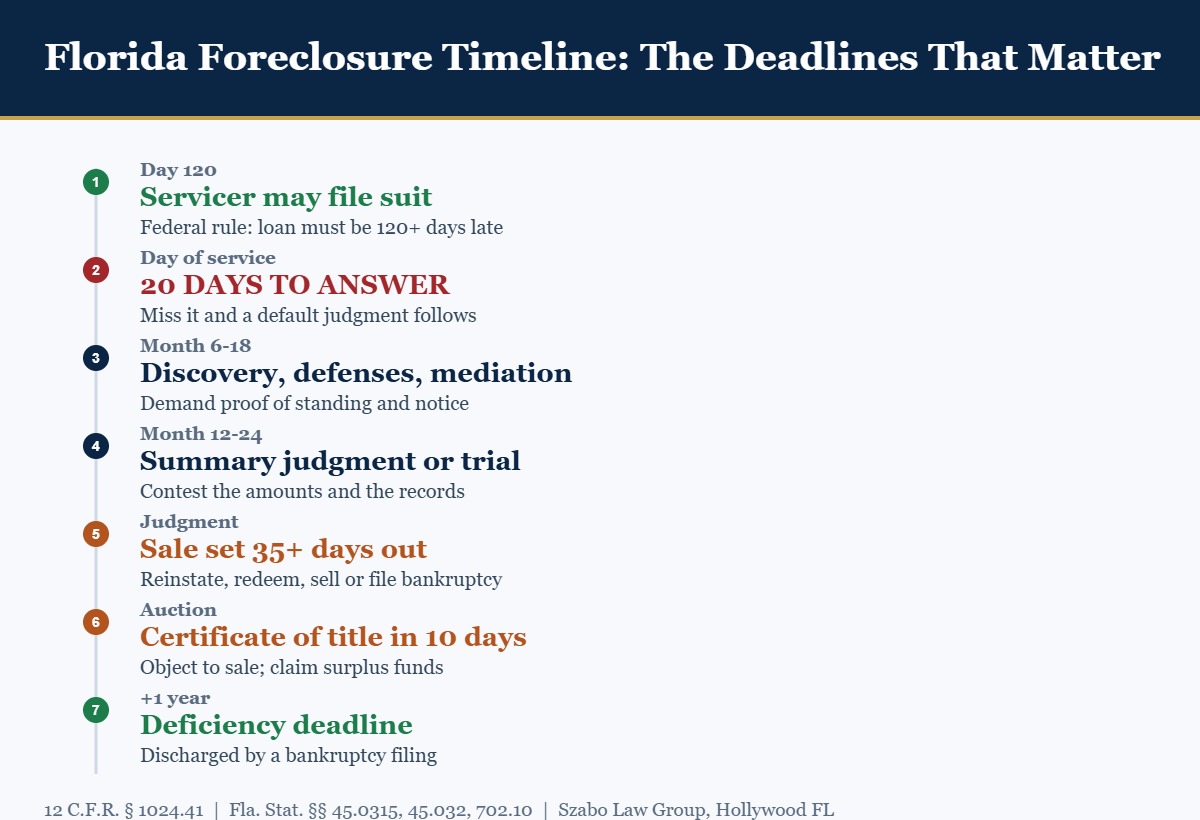
The 20-day answer deadline decides most cases
Once you are served, you have 20 days to file a written answer with the court. Do nothing and the lender moves for a clerk’s default, after which your defenses are gone and the case proceeds to judgment almost automatically. A large share of homeowners who lose a foreclosure in Florida never lost on the merits — they simply never responded.
8 Ways to Stop a Foreclosure in Florida
1. Answer the complaint and force the lender to prove its case
Filing a timely answer with affirmative defenses is the single highest-value step available. It converts an administrative march toward auction into actual litigation, where the lender must produce the original note, the payment history and admissible business records. Cases stall or settle at this stage far more often than homeowners expect.
2. Challenge standing and the chain of assignments
The plaintiff must have owned or held the note at the moment the complaint was filed. Loans are sold and securitized repeatedly, and gaps, back-dated assignments and missing endorsements are common. If the plaintiff cannot establish standing at filing, the case is subject to dismissal — one of the most effective defenses in any foreclosure in Florida.
3. Raise the five-year statute of limitations
An action to foreclose a mortgage in Florida must be brought within five years. Because most mortgages are installment obligations, each missed payment can start its own clock, and older defaults may already be time-barred even where more recent ones are not. Where a loan was previously accelerated and the case dismissed, the limitations analysis becomes a genuine battleground.
4. Use loss mitigation — and hold the servicer to Reg X
Modification, forbearance, a repayment plan or a partial claim can all end a case. Federal rules also prohibit “dual tracking”: once you submit a complete loss mitigation application more than 37 days before a scheduled sale, the servicer generally may not move for judgment or sale until it has evaluated the application and any appeal is resolved. Document every submission — those records become evidence.
5. Reinstate or redeem the loan
Reinstatement means paying the arrears, fees and costs to bring the loan current, and it is often available right up to the judgment. Redemption under Fla. Stat. § 45.0315 goes further: you may pay the full judgment amount and stop the process at any point before the clerk files the certificate of sale, or the later date stated in the judgment.
6. Sell the property or negotiate a deed in lieu
If keeping the home is not realistic, a short sale or a negotiated deed in lieu of foreclosure ends the case on terms you help shape — frequently including a written waiver of any deficiency. It also does noticeably less damage to your credit than a completed foreclosure in Florida.
7. File Chapter 13 to cure the arrears over time
Chapter 13 is the strongest tool for a homeowner who has income but has fallen behind. The automatic stay under 11 U.S.C. § 362 halts the sale immediately, and the plan lets you cure the entire arrearage over three to five years while making regular ongoing payments. Second mortgages that are completely underwater can sometimes be stripped off entirely. Chapter 13 also pairs well with efforts to stop a wage garnishment or stop a vehicle repossession at the same time.
8. File Chapter 7 to stop the sale and kill the deficiency
A Chapter 7 case also triggers the automatic stay, which stops a scheduled auction the day it is filed. Chapter 7 will not cure arrears, so it is usually the right answer when you have decided to let the house go — it discharges any deficiency and wipes out other unsecured debt, giving you a clean landing rather than a judgment following you for years.
Defenses That Actually Win in Florida Courts
These are the arguments that come up again and again in a contested foreclosure in Florida:
- Lack of standing at filing — no proof the plaintiff held the note when suit was filed.
- Defective notice of default — the paragraph 22 breach letter omitted the cure amount, the cure deadline or the right to reinstate.
- Failure to comply with conditions precedent — including FHA, VA or USDA pre-foreclosure requirements such as a face-to-face meeting.
- Reg X violations — dual tracking, or foreclosing before day 120.
- Improper service of process — substitute service on the wrong person or at the wrong address.
- Unsupported damages — payment histories introduced without a proper business records foundation.
- Statute of limitations — as described above.
None of these are technicalities for their own sake. Each one goes to whether the party asking a judge to take a family’s home has actually proven it is entitled to do so.
Five Mistakes That Cost Homeowners Their House
Much of the damage in a foreclosure in Florida is self-inflicted, and it is usually one of these five:
- Ignoring the summons. The 20-day clock runs whether or not you open the envelope.
- Relying on verbal promises. “We’re reviewing you for a modification” is not a legal defense unless the application is documented and complete.
- Moving out early. Vacating does not end the debt, and an empty house invites code violations, vandalism and insurance problems that get added to the judgment.
- Paying a rescue company up front. Advance-fee foreclosure rescue is illegal in Florida; genuine help does not require cash before any service is performed.
- Filing bankruptcy the morning of the auction without a plan. The stay stops the sale, but a case filed without the paperwork to back it up gets dismissed — and a second filing may not stop the next sale.
Order to Show Cause: When the Lender Tries to Speed Things Up
Under Fla. Stat. § 702.10, a lender can ask the court to enter an order to show cause requiring the homeowner to explain, at an early hearing, why a final judgment should not be entered immediately. If you fail to appear or fail to raise a genuine defense, judgment can be entered on the spot — compressing a foreclosure in Florida from many months to a matter of weeks. Any show-cause order should be treated as an emergency and answered in writing before the hearing.
What Happens After the Auction
Deficiency judgments
If the sale brings less than the debt, the lender may pursue the shortfall. For residential property with no more than four units, the deadline to seek a deficiency is one year, running from the day after the clerk issues the certificate of title. A bankruptcy discharge eliminates that exposure entirely.
Surplus funds
When a third-party bidder pays more than the total judgment, the excess belongs to you — not to the lender. Fla. Stat. § 45.032 governs the claim, and it must be filed within the statutory window. Surplus-recovery outfits routinely solicit homeowners for a large cut of money they could claim themselves.
Possession
Title passes when the clerk issues the certificate of title, ordinarily ten days after the sale if no objection is filed. The new owner then requests a writ of possession from the court; the sheriff, not the buyer, carries it out. You do not have to leave the day of the auction — eviction is a separate final step in a foreclosure in Florida.
Florida Homestead Protection and Bankruptcy
Florida’s constitutional homestead exemption is unlimited in value — one of the strongest in the country — covering up to one-half acre inside a municipality or 160 acres outside one. Two federal limits apply in bankruptcy:
- You must have been domiciled in Florida for the 730 days before filing to use Florida’s exemption at all.
- Equity acquired within 1,215 days (about 40 months) before filing is capped at $214,000 under 11 U.S.C. § 522(p), an amount adjusted every three years and current from April 1, 2025.
For long-time Florida homeowners, neither limit usually bites — which is precisely why bankruptcy is so often the right answer to a foreclosure in Florida rather than a last resort.
What a Foreclosure in Florida Does to Your Credit
A completed foreclosure stays on a credit report for seven years from the first delinquency, and typically costs a borrower with good credit somewhere between 100 and 160 points. A negotiated short sale or deed in lieu generally does less damage and, more importantly, shortens the waiting period before you can finance another home. Conventional loans usually require seven years after a foreclosure but as little as two to four years after a short sale or a Chapter 13 discharge, and FHA financing can be available in three years — or sooner with documented extenuating circumstances. In other words, how a foreclosure in Florida ends matters as much for your future as whether it ends.
HOA, Condo and Tax Foreclosures Are Different
A homeowners’ or condominium association can foreclose its own lien for unpaid assessments, and those cases move faster and involve much smaller sums. County tax deed sales follow an entirely separate statutory track after property taxes go unpaid. Both can cost you the house even when the mortgage is perfectly current, and both are frequently resolved through a Chapter 13 plan.
How a Hollywood, FL Foreclosure Defense Attorney Can Help
The first job is to read the file: who filed, what they attached, whether the notice was proper and whether the deadlines were met. From there the strategy might be litigation, a modification pushed through under federal servicing rules, a negotiated exit, or a bankruptcy filing timed to stop a sale. What rarely works is waiting to see what the mail brings next.
Szabo Law Group defends homeowners across Broward County from offices in Hollywood, Fort Lauderdale, Orlando and Jacksonville. If you have been served — or expect to be — call (954) 361-9091 or request a free consultation. You can also read more about our foreclosure defense services in Hollywood, FL.
Frequently Asked Questions About Foreclosure in Florida
How long does a foreclosure in Florida take?
Roughly five to eight months if nobody defends it, and commonly 12 to 24 months when the homeowner files an answer and litigates. Court backlogs, mediation and loss mitigation review all add time.
Can I stop the sale the week before the auction?
Yes. Filing a bankruptcy petition triggers the automatic stay immediately and cancels a scheduled sale. Reinstating or redeeming also works, and a motion to cancel the sale may be available where there is a pending loss mitigation application.
How many payments can I miss before foreclosure starts?
Federal rules generally require the loan to be more than 120 days delinquent — about four missed payments — before a servicer can begin a foreclosure in Florida.
Will I still owe money after the house is sold?
Possibly. If the sale price falls short, the lender has one year from the certificate of title to seek a deficiency judgment. That debt is dischargeable in bankruptcy.
Does filing bankruptcy mean I lose my house?
No. Chapter 13 is designed to let you keep it while catching up on arrears, and Florida’s unlimited homestead exemption protects the equity of long-time residents in both chapters.
Can I get the extra money if my home sells for more than I owe?
Yes. Surplus funds belong to the former owner under Fla. Stat. § 45.032. You can file the claim yourself; you do not have to surrender a percentage to a recovery company.
Is a loan modification still possible after the lawsuit is filed?
Yes. Servicers evaluate applications well into litigation, and many Florida cases end in a modification agreed during court-ordered mediation.
Key Takeaway
Because every foreclosure in Florida is a court case, the homeowner has rights that exist nowhere in a non-judicial state — the right to be served, to answer, to demand proof, and to be heard before a judge signs anything. Those rights expire on a schedule. The best outcomes come from homeowners who respond within 20 days, not from those who wait for the auction notice.
Sources and further reading: CFPB Regulation X, 12 C.F.R. § 1024.41 (loss mitigation procedures) and Fla. Stat. § 45.0315, Florida Senate.
Disclaimer: This article provides general legal information about foreclosure in Florida. It is not legal advice and does not create an attorney-client relationship. Statutes, dollar amounts and servicing rules change; consult a licensed Florida attorney about your specific circumstances.